Skip to content
A fictional clinician studies an artificial facial teaching bust and an illustrative external eyelid sketch while taking notes in a medical learning room.

Periocular surgery · Self-paced course

Cosmetic
Eyelid
Surgery

Upper and lower blepharoplasty.
Assessment, planning and review.

Connect eyelid appearance with skin, volume, brow position and support. Compare individual plans for upper and lower blepharoplasty while prioritizing ocular surface health, protective closure and patient goals.

Build a reasoned plan for adult primary cosmetic eyelid surgery, from upper and lower assessment to tissue preservation, recovery and outcome review.

Choose a package
Lessons in the full course
20
Thematic modules
5
Format
Self-paced
Course access
After payment

For clinicians with periocular surgery knowledge

Understand the eyelid.
Plan for the individual.

Designed for oculoplastic surgeons, plastic and facial plastic surgeons with periocular surgery experience, and advanced surgical trainees with prior knowledge of eyelid anatomy and ophthalmic assessment.

The curriculum focuses on elective primary cosmetic upper and lower blepharoplasty in adults. It connects skin excess, fat distribution, volume, brow position and eyelid support with ocular surface health, closure and individual goals. True ptosis, functional visual complaints and concerning ocular or orbital findings may require an additional or different pathway. Comprehensive ptosis correction, brow or forehead lifting, pediatric surgery, thyroid eye disease, tumor surgery, major trauma, reconstruction and complex revision are outside the core curriculum. Dedicated crease creation and comprehensive resurfacing, filler or fat-grafting protocols are also outside its procedural scope.

Skills you will practice

Assess the appearance.
Preserve protective function.

01

Build a structured eyelid assessment

Connect appearance concerns with examination of skin, volume, brow position, eyelid support, ocular surface and closure. Document baseline asymmetry, uncertainty and further assessment needs.

02

Compare individual upper and lower plans

Weigh candidacy, alternatives, tissue preservation and approach selection. Relate upper skin and fat decisions and lower access, volume and support options to the documented problem and evidence limits.

03

Plan follow-up and review outcomes

Discuss goals, risks and realistic expectations. Distinguish routine recovery from urgent visual or orbital concerns, then review persistent symptoms, eyelid position and patient-reported outcomes.

Course curriculum

From eyelid assessment
to planning and outcome review.

20 lessons across five modules. Open a lesson to explore its objective, topics and independent exercise prompt.

$19 package: lessons 1–10$29 package: lessons 1–20

Module 01 · Lessons 1–4

Eyelid Anatomy and Aesthetic Assessment

Connect eyelid appearance with anatomy, brow position, ocular surface health and protective function.
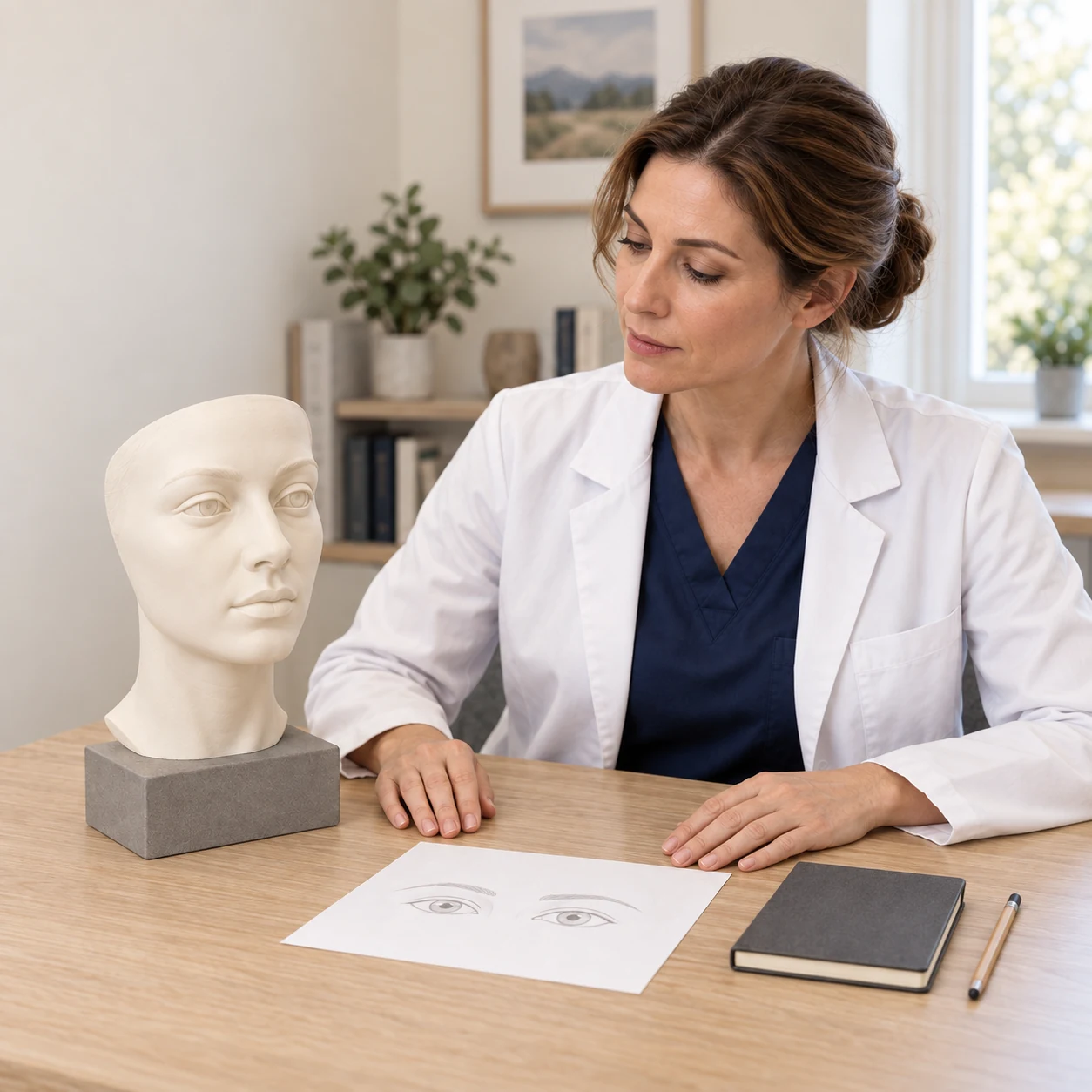
A fictional clinician studies an artificial facial teaching bust and an unlabelled external eye-and-brow sketch in a medical learning room.
01Eyelid Anatomy and Support Structures

Learning objective

Relate eyelid layers, fat compartments, retractors and support structures to appearance, blinking and protection of the ocular surface.

In this lesson

  • Anterior and posterior eyelid layers: skin, orbicularis, tarsus and conjunctiva. Relate these tissues to mobility, stability and closure instead of treating the eyelid as a removable skin fold.
  • Orbital septum, upper and lower fat compartments, upper eyelid retractors and crease relationships. Distinguish manufactured models and surface photographs from the three-dimensional relationships encountered in clinical assessment.
  • Medial and lateral canthal support, lower eyelid position and the globe–cheek relationship. Connect structural support with the contact between the eyelid and ocular surface.
  • Anatomical variation and baseline asymmetry: document the individual configuration before considering tissue removal, redistribution or support. Descriptive anatomy alone does not select an operation.
Independent exercise prompt

Create an annotated structure-and-function map for a fictional adult with upper hooding and lower fullness. For each visible concern, list the relevant tissues and one finding that requires direct clinical examination before planning.

02Periorbital Aging, Brow Position, and Facial Balance

Learning objective

Describe periocular appearance through interacting skin, volume, brow and facial relationships while preserving the patient’s individual goals.

In this lesson

  • Skin redundancy, tissue laxity, fat prominence, volume depletion and changing lid–cheek contour as distinct possible contributors. A single description such as tired eyes does not identify the tissue problem.
  • Brow position, forehead activity and upper eyelid appearance. Evaluate their interaction and baseline configuration when comparing an eyelid-focused plan with assessment of an additional brow contributor.
  • Separate upper sulcus hollowing, lower fat prominence, tear-trough shadow, skin texture and pigmentation. Include malar concerns in the assessment without assuming that blepharoplasty corrects all of them.
  • Use consistent photographs and patient descriptions to document appearance. Respect individual crease configuration and preferences; chronological age or a standard beauty target does not determine the desired correction.
Independent exercise prompt

Compare fictional presentations of upper hooding, lower fullness and lower hollowing. Produce separate problem lists and explain how identical patient language could conceal different tissue and planning questions.

03Upper and Lower Eyelid Examination

Learning objective

Organize a reproducible upper and lower eyelid examination and record findings, uncertainty and indications for ophthalmic assessment.

In this lesson

  • Record eye and periocular history, previous surgery or procedures, contact lens use, symptoms, medication history and the patient’s cosmetic priorities. Distinguish an appearance concern from new visual symptoms.
  • Document skin, crease, lid margin position, upper eyelid movement, brow position, baseline asymmetry, closure and lower eyelid support. Photographs supplement examination and do not substitute for assessment of function.
  • Clinical ocular assessment includes relevant visual and motility findings and the ocular surface. An abnormal or concerning finding changes the clinical question and may require further ophthalmic investigation before elective planning.
  • Record reproducible baseline appearance and symptom information. Separate observations from interpretations and use patient-reported measures when appropriate; a questionnaire score does not diagnose the tissue problem.
Independent exercise prompt

Draft a consultation record for a fictional patient requesting both upper and lower surgery. Include an examination checklist, photography plan, patient priorities and a separate list of unanswered questions requiring further assessment.

04Ocular Surface, Eyelid Closure, and Risk Screening

Learning objective

Explain how tear-film health, blinking and eyelid closure influence assessment, treatment suitability and a preservation-focused plan.

In this lesson

  • Ask about dryness, irritation, fluctuating visual symptoms and previous ocular treatment. Consider the ocular surface and existing symptoms before attributing discomfort or cosmetic concerns solely to excess eyelid tissue.
  • Assess spontaneous blink, gentle closure, incomplete closure and relevant protective function in the clinical examination. Relate exposure concerns to the proposed change in skin, muscle and eyelid position.
  • Use ocular surface examination and selected tear-film or symptom measures to answer the individual question. Symptoms and measured signs can differ; no single test is presented as a universal surgical clearance threshold.
  • Appraise studies of orbicularis handling and postoperative symptoms in their selected populations and follow-up periods. Preserved measures in one cohort do not eliminate risk or replace evaluation of a patient with existing concerns.
Independent exercise prompt

Compare two fictional adults with similar upper skin excess, one with ocular discomfort and one without. Explain what additional assessment each requires, how findings could alter candidacy and what would justify deferral or specialist review.

Module checkpoint

Prepare an assessment dossier connecting eyelid anatomy, appearance concerns, examination findings, ocular surface and closure, baseline documentation and questions requiring further evaluation.

Module 02 · Lessons 5–8

Patient Selection and Surgical Planning

Relate cosmetic goals, examination findings, alternatives and risk assessment to an individual treatment plan.

A fictional clinician and adult consultation participant discuss individual eyelid planning beside an artificial facial teaching bust and an illustrative external eye-and-brow sketch.
05Cosmetic Concerns, Alternatives, and Candidacy

Learning objective

Evaluate cosmetic goals, alternatives and suitability while identifying concerns that require additional assessment or a decision to defer intervention.

In this lesson

  • Clarify the patient’s priorities, expected changes, tolerance for scars or asymmetry and understanding of uncertainty. Connect the proposed benefit to a documented concern rather than to an assumed need for rejuvenation.
  • Compare observation, deferral, selected nonsurgical options and an eyelid procedure in relation to the identified problem. Discuss the limits and risks of alternatives without supplying a comprehensive injection or resurfacing protocol.
  • Consider eye health, general health, previous procedures and the clinical team’s competence. A request for a smaller procedure does not remove the need for an appropriate ophthalmic and perioperative assessment.
  • Recognize disproportionate appearance distress, external pressure or unrealistic expectations. Structured screening can support referral; a positive screen is not a diagnosis, and cosmetic surgery is not presented as treatment for a psychiatric disorder.
Independent exercise prompt

Write a candidacy discussion for a fictional adult asking for perfect symmetry and complete removal of every under-eye concern. Identify achievable questions, alternatives, uncertainties and circumstances requiring further assessment or deferral.

06Differentiating Skin Excess, Brow Descent, and Eyelid Ptosis

Learning objective

Distinguish eyelid skin excess, brow descent and true eyelid ptosis and explain how each changes the clinical planning pathway.

In this lesson

  • Define skin redundancy, low brow position and a low upper eyelid margin as different findings that may coexist. Document their contribution instead of using hooding or drooping as an operative diagnosis.
  • Relate upper eyelid margin position and movement to brow and skin findings. New or unexplained ptosis, visual symptoms or other concerning findings require evaluation beyond routine cosmetic skin planning.
  • Identify when an isolated blepharoplasty proposal leaves a brow or ptosis contributor unaddressed. Comprehensive ptosis correction and brow lifting are separate procedures outside the core technical teaching of this course.
  • When functional complaints are present, document their relationship to examination and consider appropriate additional evaluation. Professional guidance for upper visual-field impairment is not a universal cosmetic eligibility or insurance rule.
Independent exercise prompt

Compare fictional cases dominated by skin excess, brow descent and true eyelid ptosis. State the observed distinctions and justify an eyelid-focused plan, additional assessment or a separate specialist pathway for each.

07Preoperative Assessment and Informed Consent

Learning objective

Structure preoperative assessment and consent around health factors, ocular risks, alternatives and the patient’s informed decision.

In this lesson

  • Review relevant health conditions, allergies, previous procedures, prescribed medicines, supplements and factors affecting bleeding, healing or anesthesia. Coordinate medication decisions with the appropriate clinicians instead of applying a universal stop list.
  • Discuss anesthetic and facility planning, follow-up access and the responsibilities of the treating team. The setting and anesthesia choice are individualized and depend on the procedure, patient and professional requirements.
  • Explain possible dryness, closure problems, lower eyelid malposition, asymmetry, scarring, bleeding, infection, visual changes and further treatment. Match the discussion to the individual plan and avoid unsupported risk percentages.
  • Document goals, alternatives including no surgery, uncertainties and the patient’s understanding. Allow an informed decision without pressure; local consent requirements and the patient’s vulnerabilities remain relevant.
Independent exercise prompt

Prepare a consent-discussion outline for a fictional adult with ocular symptoms and a medicine relevant to bleeding risk. Identify needed specialist coordination, procedure-specific questions and how understanding will be documented.

08Integrated Upper and Lower Eyelid Planning

Learning objective

Synthesize an integrated upper and lower eyelid plan linking each proposed component to a documented problem and preservation priority.

In this lesson

  • Combine the appearance problem list with skin, fat, volume, brow, eyelid support and ocular surface findings. State what is confirmed, what remains uncertain and which goals are outside the likely scope of an eyelid procedure.
  • Compare an upper-only, lower-only, combined or staged plan according to the patient’s priorities and findings. A request for both eyelids does not itself justify combining all available interventions.
  • Link each component to a rationale, alternatives, tissue and support needs, risks and conditions for reconsideration. Identify the additional brow, ptosis, ocular or revision expertise required when the case exceeds the course’s primary cosmetic scope.
  • Plan reproducible photographs, symptom documentation and patient-reported follow-up before treatment. Assess appearance and protective function separately, then review their relationship to the agreed goals.
Independent exercise prompt

Build a one-page integrated plan for a fictional adult with upper hooding, lower fullness and ocular irritation. Compare two reasonable pathways, list the unresolved findings and explain why a combined operation may or may not be appropriate.

Module checkpoint

Prepare a candidacy and consent brief with a differentiated skin–brow–ptosis problem list, alternatives, an integrated plan, preservation priorities and conditions for deferral or specialist review.

Module 03 · Lessons 9–12

Upper Eyelid Blepharoplasty

Compare upper eyelid planning principles with attention to tissue preservation, contour and eyelid closure.

Close tabletop view of a fictional clinician studying an artificial facial teaching bust beside a blank comparison grid for individual planning.
09Upper Eyelid Skin Management and Closure Preservation

Learning objective

Explain upper eyelid skin planning in relation to baseline crease, tissue availability and preservation of eyelid closure.

In this lesson

  • Relate the distribution of skin redundancy to brow position, eyelid margin and baseline crease. A surface pinch or photograph alone cannot establish that every apparent fold should be removed.
  • Discuss how preserving adequate mobile tissue supports closure and protects the ocular surface. Compare limited skin-focused planning with a more extensive proposal through the documented anatomy and function.
  • Consider crease continuity, scar placement and baseline asymmetry in the planning discussion. Individual skin and crease configurations guide the question; the course does not prescribe one excision width or crease height.
  • Identify overcorrection, incomplete closure, contour disruption and residual redundancy as possible trade-offs. Explain the importance of clinical assessment and follow-up rather than promising an entirely crease-free upper eyelid.
Independent exercise prompt

For a fictional adult with upper skin redundancy and asymmetrical brow position, explain what can be concluded from photographs and what requires direct examination. Outline a preservation-focused skin plan and the findings that could change it.

10Orbicularis and Fat Management in Upper Eyelid Surgery

Learning objective

Compare orbicularis and upper eyelid fat strategies in relation to fullness, volume preservation, blinking and patient-specific risk.

In this lesson

  • Distinguish skin redundancy, muscle-related contour, fat prominence and hollowing. The proposed management should address the identified contributor rather than automatically excising muscle or fat with every upper blepharoplasty.
  • Relate orbicularis function to blinking and closure. Compare clinical studies of skin-only and skin–muscle strategies, considering sample selection, measured endpoints and timing rather than treating one result as a universal rule.
  • Consider upper eyelid fat compartment relationships and preservation or selective modification according to contour goals. Recognize upper sulcus hollowing as a different concern from excess fullness.
  • Appraise anatomical and clinical series critically. A descriptive series or favourable short-term result does not prove that a particular volume strategy is required for every adult or eliminate ocular surface risks.
Independent exercise prompt

Create a comparison matrix for three fictional upper eyelid presentations: mainly skin excess, localized fullness and upper sulcus hollowing. Link possible tissue strategies to the observed problem, function risks and missing assessment information.

11Asymmetry and Upper Eyelid ContourFull course

Learning objective

Evaluate upper eyelid asymmetry and contour against baseline findings, patient goals and protective function.

In this lesson

  • Separate pre-existing differences in brow, crease, lid margin, volume and orbital relationships. Document what the patient notices and what the clinical examination identifies before interpreting a postoperative difference.
  • Discuss crease continuity, contour balance and residual or newly created hollowing without assigning a standard appearance to every patient. Matching an amount of tissue removal does not itself define a satisfactory individual plan.
  • Use consistent photographs, clinical findings and patient-reported experience to review appearance. Early swelling can complicate comparisons; apparent change in a photograph must be interpreted with the healing context.
  • Distinguish reasonable aesthetic uncertainty from functional concerns requiring assessment. Explain the limits of promising perfect symmetry and why clinician ratings and patient satisfaction should be reviewed together.
Independent exercise prompt

Prepare a baseline-versus-follow-up review for a fictional adult with different upper creases and eyebrow positions. Identify which observations are cosmetic, which concern function and which cannot yet support a further treatment decision.

12Upper Eyelid Blepharoplasty: Case-Based PlanningFull course

Learning objective

Justify an upper eyelid plan through a structured fictional case, including alternatives, preservation priorities and review criteria.

In this lesson

  • Synthesize the upper eyelid concern, brow and ptosis findings, ocular surface assessment and health factors. Establish a focused clinical question before comparing skin, muscle or fat components.
  • Compare more than one reasonable planning pathway and the decision to defer treatment. Explain each proposal through the tissue problem, risks, patient preference and uncertainties rather than a favoured technique.
  • Identify conditions that require additional ophthalmic, ptosis, brow or revision assessment. The core case remains primary cosmetic blepharoplasty, with other procedures discussed as boundaries or additional pathways.
  • Define review criteria for appearance, closure, symptoms and the patient’s goals. Use outcome evidence to structure assessment without presenting a group result as a prediction of individual satisfaction.
Independent exercise prompt

Write a case-planning brief for a fictional adult with upper hooding, localized fullness and a concern about changing their characteristic crease. Compare two pathways, justify your preferred next step and list the findings that could reverse that decision.

Module checkpoint

Create an upper eyelid decision matrix relating skin, orbicularis and fat strategies to the individual contour, closure, baseline asymmetry and patient goals, with an explicit appraisal of the evidence limits.

Module 04 · Lessons 13–16

Lower Eyelid Blepharoplasty

Compare access, skin and fat strategies, lid–cheek contour and support needs in an individual lower eyelid plan.

A fictional clinician studies an artificial facial teaching bust and an illustrative external eye-and-cheek contour on a screen-up tablet.
13Lower Eyelid Approaches: Transconjunctival and TranscutaneousFull course

Learning objective

Compare lower eyelid surgical approaches according to skin, fat, support and access needs while explaining the limits of comparative evidence.

In this lesson

  • Describe transconjunctival and transcutaneous access as different routes to selected lower eyelid problems. Compare their relationship to anterior tissues, orbital fat and the documented skin concern.
  • A transconjunctival route does not itself remove external skin; any separate skin treatment needs its own rationale. A transcutaneous approach also requires attention to tissue handling, closure and lid position.
  • Include baseline lower eyelid support and the globe–cheek relationship in approach planning. Discuss the implications for malposition and ocular surface function without assigning every patient the same route or adjunct.
  • Appraise small comparative studies and uncontrolled clinical series separately. Differences in side assignment, selection, combined procedures and follow-up limit claims that one access route is universally superior.
Independent exercise prompt

Compare access options for two fictional adults: one with lower fullness and little apparent skin redundancy, and one with skin redundancy and a support concern. State the examination needed and why the same approach may not suit both.

14Lower Eyelid Fat, Tear Trough, and Lid–Cheek ContourFull course

Learning objective

Relate lower eyelid fat and lid–cheek contour strategies to the distinction among prominence, hollowing, skin changes and adjacent facial concerns.

In this lesson

  • Map orbital fat prominence, tear-trough hollowing and the lid–cheek transition as related but distinct findings. Assess skin texture, pigmentation and malar concerns separately rather than grouping them all as under-eye bags.
  • Compare selective fat reduction, preservation and repositioning as possible strategies for an identified problem. Explain the desired contour, tissue availability and uncertainty; no fat strategy is presented as mandatory.
  • Consider the influence of adjacent cheek and orbital relationships when interpreting a volume proposal. A hollow-appearing region does not establish that a specific injection or fat-grafting protocol is appropriate.
  • Review technique series with attention to mixed primary/revision populations, combined procedures, residual deformity and outcome assessment. Favourable reported contours do not guarantee correction of every under-eye concern.
Independent exercise prompt

Build a concern-to-strategy table for fictional lower fullness, tear-trough hollowing and predominantly pigmentation. List the additional findings needed and explain which expectations a blepharoplasty-focused plan may not address.

15Lower Eyelid Laxity and Support PlanningFull course

Learning objective

Assess lower eyelid support needs and explain the rationale and uncertainty behind a selected support component.

In this lesson

  • Examine lower eyelid position, laxity, lid–globe contact, canthal relationships and the globe–cheek configuration. Interpret support testing with the whole examination rather than through a universal single cut-off.
  • Connect a support concern with the proposed skin, fat and access plan. Describe the purposes and selection questions for canthal support without turning every lower blepharoplasty into a mandatory support operation.
  • Discuss lower eyelid retraction, ectropion, altered contour and ocular surface exposure as concerns in planning and follow-up. Baseline malposition or substantial previous surgery may require a different reconstructive or revision pathway.
  • Critically review series that combine transcutaneous surgery and support. A report of routine support without a comparable no-support group cannot establish the independent benefit or necessity of that component.
Independent exercise prompt

Prepare a support rationale for a fictional adult with lower skin redundancy and suspected laxity. Separate findings requiring confirmation, possible planning implications and the evidence needed before calling any support manoeuvre essential.

16Lower Eyelid Skin Management and Adjunctive ProceduresFull course

Learning objective

Evaluate lower eyelid skin and adjunctive treatment proposals in relation to tissue preservation, support and the limits of the cosmetic goal.

In this lesson

  • Distinguish skin redundancy from wrinkles, pigmentation and volume or support problems. Explain what a skin-focused component seeks to change and what remains outside its expected purpose.
  • Compare limited skin management with a broader anterior tissue proposal through the examination and other planned components. Consider closure and lower eyelid position; no fixed removal amount is adopted.
  • Discuss resurfacing or other selected adjuncts as separate candidacy, risk and consent questions. Comprehensive laser, peel, filler and fat-grafting protocols are outside the core procedural teaching.
  • Evaluate skin-pinch and other technique series in their selected patients and combined-treatment context. The absence of major complications in a small series cannot establish universal safety or predict an individual outcome.
Independent exercise prompt

Create an adjunct decision brief for a fictional adult seeking correction of lower fullness, fine wrinkles and dark circles. Assign each concern to an assessment question, specify the limits of an eyelid procedure and compare combined treatment with deferral.

Module checkpoint

Compare lower eyelid access, fat and skin options with support needs in fictional cases; justify each proposed component and explain unaddressed concerns, malposition risk and uncertainty.

Module 05 · Lessons 17–20

Recovery, Complications, and Outcome Review

Plan follow-up, distinguish urgent concerns from expected healing and evaluate appearance and eyelid function.

Two fictional clinical colleagues review generic follow-up teaching materials on a screen-up tablet and a neutral paper worksheet.
17Postoperative Care and Follow-UpFull course

Learning objective

Organize individualized postoperative instructions and follow-up that document healing, ocular function and patient concerns.

In this lesson

  • Provide a clear postoperative contact and review plan agreed by the treating team. Instructions address eye and incision care, prescribed treatment, activity and concerns according to the individual procedure and clinical findings.
  • Document swelling, bruising, discomfort and ocular symptoms in the healing context while checking closure and relevant visual findings. A symptom described as common in patient information still requires interpretation in the actual patient.
  • Make urgent-contact instructions accessible and distinguish them from a routine appointment. Arrange clinical review when symptoms or findings depart from the expected course; no uniform medication or recovery schedule is imposed.
  • Repeat appropriate photographs, symptom measures and patient-reported assessment under consistent conditions. Include unresolved concerns and further review needs rather than treating the first follow-up as the final cosmetic result.
Independent exercise prompt

Draft a follow-up and communication checklist for a fictional adult after combined upper and lower blepharoplasty. Include the information needed at each review, individualized instruction categories and a clear distinction between routine questions and urgent concerns.

18Recognizing Urgent Visual and Orbital ComplicationsFull course

Learning objective

Recognize concerning postoperative visual or orbital changes and explain the need for immediate clinical assessment and escalation.

In this lesson

  • New or worsening loss of vision, severe or escalating pain, rapidly increasing swelling, or concerning diplopia requires urgent contact and clinical assessment rather than reassurance based only on expected bruising.
  • Understand postoperative orbital haemorrhage as a rare but potentially sight-threatening concern. Historical surgeon surveys inform awareness but cannot provide a precise modern risk estimate for every patient or procedure.
  • Assess the reported change against relevant clinical findings and escalate suspected visual or orbital compromise promptly through the available emergency ophthalmic or surgical pathway. Avoid delaying urgent assessment to collect routine photographs or await a scheduled visit.
  • Explain clear warning-sign communication and access to the treating team or emergency services. This lesson addresses recognition and escalation; decompression techniques, drug regimens and unsupervised home treatment are outside its teaching scope.
Independent exercise prompt

Use a fictional postoperative report of worsening pain, rapid unilateral swelling and a visual change. Write an urgent escalation communication stating the known facts, missing clinical information and why routine follow-up timing is inappropriate.

19Dry Eye, Eyelid Malposition, and Persistent ConcernsFull course

Learning objective

Reassess persistent symptoms and eyelid position changes through the ocular surface, closure, support and healing context before considering further intervention.

In this lesson

  • Evaluate persistent dryness or irritation with ocular surface and eyelid examination. Consider blink, closure, baseline symptoms and treatment history rather than attributing every complaint to one tissue-removal decision.
  • Document incomplete closure, lower retraction, ectropion or a contour concern through direct clinical findings. Assess functional impact and the need for timely specialist care instead of labeling all residual changes as cosmetic dissatisfaction.
  • Review scars, asymmetry, residual skin or volume concerns against baseline documentation, healing and patient goals. Concerning symptoms can require assessment immediately; decisions about elective further surgery require their own clinical rationale.
  • Recognize that selected primary-procedure studies and historical correction series do not provide a universal revision algorithm. Complex repair is outside the course, and persistent complaints may require an additional ocular, reconstructive or revision pathway.
Independent exercise prompt

Create a reassessment brief for a fictional adult reporting persistent irritation and lower lid position change. Separate ocular surface, closure, support and cosmetic questions, identify urgent findings and justify the next assessment pathway.

20Case-Based Planning and Outcome ReviewFull course

Learning objective

Integrate case planning and outcome review using documented goals, tissue findings, protective function and the patient’s experience.

In this lesson

  • Assemble the full assessment, candidacy, consent and upper/lower plan for fictional cases. Explain the link between each proposed component and the problem list, preservation priorities, alternatives and unresolved questions.
  • Review appearance, eyelid position, closure, ocular symptoms and patient-reported outcomes as complementary domains. FACE-Q measures can support structured review using an appropriate validated version; scores are not diagnoses or guaranteed benefit thresholds.
  • Distinguish observed associations from prediction and causation. Interpret cohort satisfaction findings and professional quality-of-life assessments within their populations, procedures and timing rather than promising a specific patient result.
  • Communicate achieved and unmet goals, concerns requiring further investigation and a justified follow-up plan. A satisfactory photograph alone does not establish symptom resolution, and an additional procedure is not the automatic response to dissatisfaction.
Independent exercise prompt

Complete a fictional two-case portfolio: upper hooding with a brow/closure question, and lower fullness with a support/volume question. Provide the assessment, alternatives, consent priorities and individual plan, then audit fictional follow-up findings against function and agreed goals.

Module checkpoint

Complete the fictional case-planning portfolio and follow-up audit, including appearance, ocular function, patient experience, urgent communication and a justified pathway for unresolved concerns.

Selected reading · 30 sources

Self-paced study

Assess.
Compare.
Explain your plan.

Work through the curriculum at your own pace, supported by 30 primary or official sources. Use independent fictional case and decision exercise prompts to connect appearance concerns, function and treatment options, then review your reasoning at each module checkpoint.

  1. Review the lessonWork through its objective, topics and selected reading to identify the assessment or planning question.
  2. Develop your reasoningUse the independent exercise prompt to construct a fictional assessment, compare pathways and record missing information.
  3. Bring the plan togetherUse the five module checkpoints to connect your decisions, then complete the integrated fictional case and follow-up review exercise.
A fictional clinician in navy scrubs studies an illustrative learning page on a laptop while taking notes in a bright medical learning room.
Independent study and clinical reasoning. Course artwork depicts fictional learning settings; it does not show actual faculty, patients or treatment results.

Practical exercises

Connect eyelid findings
with reasoned decisions.

The full curriculum includes 20 independent exercise prompts. Assessment, comparison and fictional planning tasks help you connect patient goals with tissue preservation, consent priorities and follow-up decisions.

Eyelid anatomy, function and appearance mapping

Structured eye and eyelid examination

Goals, candidacy, alternatives and consent

Upper eyelid preservation and contour comparison

Lower eyelid access, volume, skin and support

Fictional case planning, warning signs and outcome review

Two course packages

Choose your level of study.

One-time payment in USD. Self-paced course.
Access to your chosen package after payment.

First 10 lessons

Half course

$19USD · one-time

Start with eyelid anatomy and structured assessment, then connect candidacy and individual planning with upper eyelid skin preservation, orbicularis and fat management.

  • Lessons 1–4: anatomy, appearance, examination, ocular surface and closure
  • Lessons 5–8: candidacy, differential assessment, consent and integrated planning
  • Lessons 9–10: upper eyelid skin, orbicularis and fat management
  • Independent exercise prompts for lessons 1–10
  • Learn at your own pace
Choose the $19 package

All 20 lessons · 5 modules

Full course

$29USD · one-time

The complete program: upper and lower assessment, individual planning, tissue preservation, lower eyelid approaches, skin and support, recovery and outcome review.

  • Everything in the first 10 lessons
  • Lessons 11–12: upper eyelid contour and case-based planning
  • Lessons 13–16: lower approaches, fat, lid–cheek contour, skin and support
  • Lessons 17–20: care, urgent concerns, persistent symptoms and outcomes
  • 20 independent exercise prompts and all five module checkpoints
Choose the $29 package
01

Choose a package
and complete the form.

02

Receive a payment link
manually by email.

03

After payment
get access to your selected package.

Course application

Build your next
eyelid surgery plan.

Leave your name and email. We will send a payment link for your chosen Cosmetic Eyelid Surgery package manually.

Pay using the link we send after receiving your application.

Course questions

Before you
start learning.

Have another question?
Contact us

Who is this course for?

Oculoplastic surgeons, plastic and facial plastic surgeons with periocular surgery experience, and advanced surgical trainees with a foundation in eyelid anatomy and ophthalmic assessment. It focuses on elective primary cosmetic upper and lower blepharoplasty in adults.

What is the difference between the $19 and $29 packages?

The $19 package covers lessons 1–10: eyelid anatomy, assessment, candidacy, integrated planning and upper eyelid skin, orbicularis and fat management. The $29 package includes all 20 lessons, adding upper contour and case planning, lower eyelid approaches, fat and lid–cheek contour, skin and support, recovery, complications and outcome review.

How should I study the course?

Work at your own pace through the lesson objectives, topics and selected reading. Develop your reasoning with the independent exercise prompts and connect your decisions at each module checkpoint.

How do I apply and get access?

Choose a package, enter your name and email in the form, and select ‘Send application’. We will email you a payment link manually. Access to your selected package is provided after payment.

What exercises are included?

The full program provides 20 independent lesson exercise prompts and five module checkpoints for assessment, comparison, consent, planning and follow-up. These are prompts for your own work, rather than prepared patient case packets or downloadable worksheets. The $19 package includes the prompts for lessons 1–10.

Does the course cover ptosis correction or brow lifting?

It teaches how to recognize true ptosis, brow contributors and functional visual complaints that may change the assessment or require a different pathway. Comprehensive ptosis correction, brow lifting and complex revision are outside the core procedural curriculum.

Do the illustrations show actual patients or instructors?

The artwork depicts fictional people, study models and learning settings. It illustrates curriculum themes and does not document actual faculty, patients, treatment results or a course-platform interface.